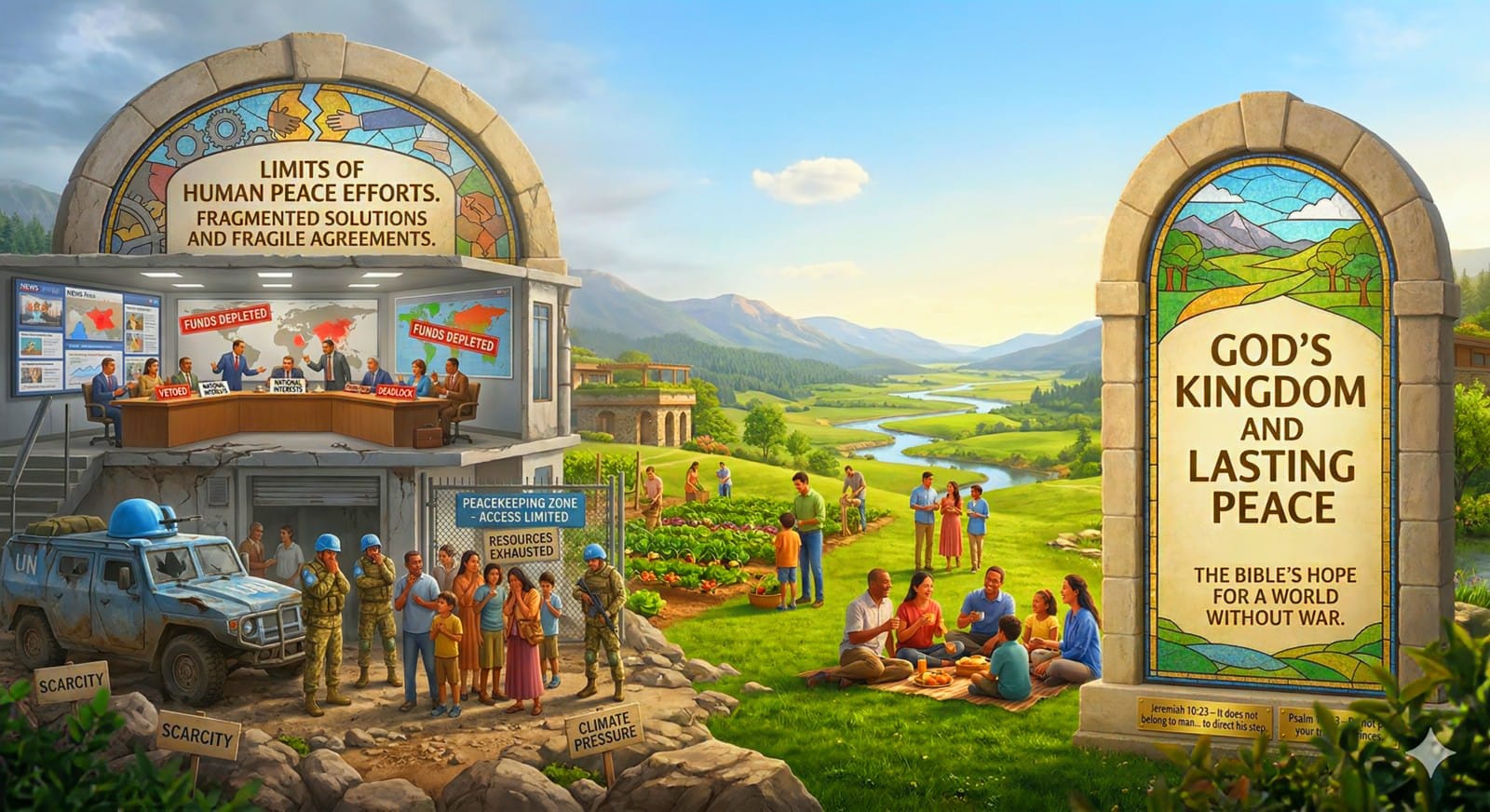
Human efforts to preserve peace are often sincere. International organizations, negotiations, sanctions, peacekeeping missions, and humanitarian agreements have all aimed to reduce violence and protect lives. Yet the world continues to experience deep instability. Severe geopolitical tensions, prolonged wars, strained peacekeeping operations, budget shortfalls, and worsening pressures tied to resources and climate all reveal the same reality: human institutions, however sincere, cannot fully overcome the problems rooted in flawed rulership.
The Bible helps us understand why. It does not dismiss efforts to maintain order, but it plainly shows that lasting peace requires more than diplomacy, policy, or military restraint. It requires a government entirely free of selfishness, division, corruption, and weakness — the very hallmark of God’s Kingdom.
Geopolitical Division Limits Human Action
One of the greatest challenges to global peace is the deep polarization among powerful nations. When major powers are divided, decisive action is delayed or blocked. Rival national interests frequently overpower shared moral purpose, and unity gives way to stalemate.
This is a recurring weakness in human governance. Even institutions that are designed to promote peace depend on imperfect rulers whose decisions are shaped by strategy, pressure, and self-interest.
— Jeremiah 10:23
God’s Kingdom does not suffer from rivalry among competing states or leaders. It is a single, unified government under perfect authority. Its decisions are never obstructed by vetoes, national agendas, or political posturing.
— Daniel 2:44
Complex Conflicts Expose the Limits of Human Solutions
Modern conflicts are increasingly prolonged, fragmented, and difficult to resolve. Many involve militias, non-state actors, shifting alliances, terrorism, criminal networks, and disinformation. Even when ceasefires are achieved, tensions often remain unresolved, and violence returns.
Human institutions can sometimes contain conflict temporarily, but they cannot remove the deeper causes of hostility. Agreements may regulate behavior for a time, yet they do not erase hatred, greed, pride, or vengeance.
— Mark 7:21,22
God’s Kingdom is fully capable of doing what human governments cannot: addressing the root causes of conflict. Rather than merely managing violence, it removes the conditions that produce it and teaches people a new way of living in peace.
— Psalm 46:9
— Isaiah 2:4
Peacekeeping Forces Face Danger, Strain, and Human Limitations
Peacekeeping missions often operate in dangerous environments marked by insecurity, restrictions on movement, organized violence, and misinformation. Personnel may be asked to stabilize areas where trust has already collapsed and where their ability to protect civilians is limited by conditions beyond their control.
This highlights another weakness of human efforts: they rely on limited personnel, limited resources, and limited access. Even courageous service cannot guarantee safety or justice when the surrounding conditions remain hostile and unpredictable.
— Psalm 146:3
By contrast, God’s Kingdom is never constrained by fragile supply lines, dangerous deployments, or uncooperative parties. Its rulership is backed by divine power, perfect knowledge, and complete authority.
— Isaiah 11:4
Resource Shortages and Budget Gaps Weaken Human Protection
Peace efforts often depend on funding, logistics, political will, and ongoing support. When resources are cut or commitments are not honored, civilian protection suffers, operations shrink, and vulnerable populations are left exposed.
This is another reminder that human systems are unstable. They can promise much, but changing priorities and limited means often reduce what they can actually deliver.
— Zephaniah 3:3
God’s Kingdom does not depend on member contributions, fluctuating budgets, or human willingness to cooperate. It has unlimited capacity to accomplish its purpose and perfect consistency in carrying it out.
— Isaiah 9:7
Climate Pressure and Resource Competition Add New Layers of Conflict
Resource scarcity has long contributed to unrest, and environmental stress can intensify those tensions. Competition over food, water, land, and other resources creates additional pressure in already fragile regions. Human governments may respond with policy and aid, but their solutions are often partial and reactive.
The Bible points to something far better than crisis management. God’s Kingdom will restore planet Earth under righteous rule. Instead of scarcity, insecurity, and exploitation, it will bring stability, productivity, and peace.
— Psalm 67:6
— Isaiah 65:21
God’s government is not merely capable of settling disputes. It is capable of creating the secure conditions in which conflict no longer needs to arise from fear, deprivation, or oppression.
Low Morale and Institutional Fatigue — Why?
When organizations lose shared vision, morale suffers. Over time, repeated crises, limited progress, and internal strain can discourage even those who genuinely want to help. This too reflects the burden of human flaws. People tire. Systems weaken. Vision fades.
God’s Kingdom is entirely different. Its purpose never changes, its ruler never loses wisdom, and its justice never declines. There is no corruption in its leadership, no confusion in its direction, and no failure in its outcome.
— Psalm 145:13
Why God’s Kingdom Is Fully Capable
Human governments can provide a measure of order, but they cannot guarantee universal justice, unity, or peace. God’s Kingdom can. It is fully capable because its ruler is righteous, its authority is absolute, and its purpose is perfectly aligned with God’s will.
Unlike human systems, it is not weakened by geopolitical rivalry, moral compromise, financial limitations, or institutional fatigue. It addresses both outward conditions and inward causes. It does not simply reduce suffering for a time; it removes the basis for suffering altogether.
— Revelation 21:3, 4
The contrast is clear. Human efforts, though sincere and often beneficial, are constrained by political division and human imperfection. The Bible’s solution rests on a righteous rulership not limited by national interests or ulterior motives.
A Lasting Peace
The longing for peace and security is universal. History demonstrates the dedication of nations to achieve it. Yet Scripture points to a future where peace is not negotiated, enforced, or temporary, but permanent, just, and universal.
In that promised future, suffering, injustice, and war will not merely be reduced. They will be removed entirely.